Thursday, 22 August 2013

MiG-29s to be stationed aboard Vikramaditya and Vikrant


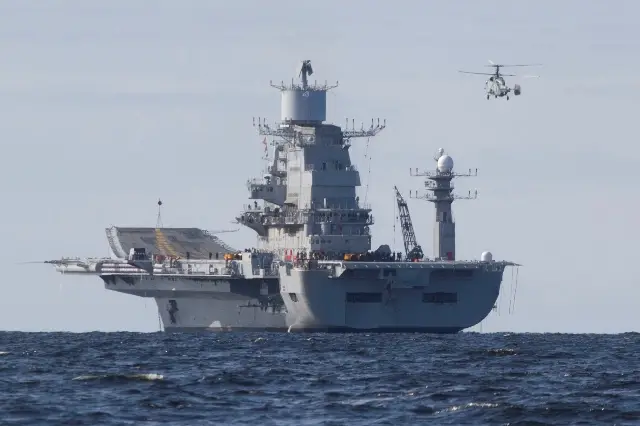
The Indian Navy’s Russian-made ship-based multirole MiG-29K/KUB jet fighters will be stationed aboard the Vikramaditya and Vikrant aircraft carriers.
India’s Defence Minister A.K. Antony told the country’s parliament on Tuesday, that the aircraft, the first squadron of which has become operational, would be deployed aboard the aircraft carriers.
Sixteen MiG-29K/KUB fighter aircraft have already been supplied to India under the main contract with Russia. Under the optional second contract, four aircraft were delivered in 2012 and in 2013.
A MiG official said that MiG had no problems with the delivery of extra 29 ship-based MiG-29K/KUB fighter planes. The planes were test flying in Goa.
Earlier, Alexander Fomin, Director of the Federal Service for Military-Technical Cooperation, said that the Vikramaditya aircraft carrier would be handed over to the Indian Navy in November 2013.
“The ship is to be put in a dock in April, go on sea trials in June and July and be officially handed over some time in November,” he said.  On September 23, 2012, the Vikramaditya returned to the shipyard to fix the problems that were detected during previous sea trials.
During the three-month sea trials the ship demonstrated excellent seaworthiness, speed of 29.3 knots and manoeuvrability. MiG specialists praised the ski-jump. The ship sailed for more than 12,000 miles, with 517 flights performed from its deck by aircraft and helicopters.
Russia’s Northern Fleet aviation was involved in the sea trials: aircraft and helicopters flew around and over the ship in order to check its radar, air defence, communication and control systems. During the first stage of the trials in the White Sea, the ship’s physical fields were measured, and the crew practiced fuelling and fresh water replenishing operations. The ship was initially scheduled to be commissioned on December 4, 2012. However its transfer to India was postponed until the end of 2013 after the problems during the sea trials.
Under a package inter-governmental agreement signed in New Delhi in January 2004, the body of the Admiral Gorshkov was transferred to India for free subject to its upgrading at Sevmash and armament with Russian aircraft.
Russia will also train the Indian crew of about 1,500 and create an infrastructure for the ship in the Indian Ocean.
The overall cost of the contract was estimated at $1.5 billion, of which about $974 million were intended for the conversion of the ship into a full-scale aircraft carrier. All work was supposed to be completed in 2008. However the completion date has been postponed. Russia claimed that the volume of work had been underestimated and demanded an additional payment of $2.2 billion.
The Admiral Gorshkov was built in Nikolayev under the name of Baku and put to service in the Northern Fleet in 1987. It is 283 metres long, 51 metres wide, with water displacement of over 45,000 tonnes.

India, Russia Discuss Submarine-Building


An Indian military delegation has arrived in St. Petersburg to discuss military-technical collaboration in submarine-building, a Russian defense industry source told RIA on Thursday, days after a Russian-made sub in India’s navy exploded.
“It is a routine meeting of a joint [Russian-Indian] working group that had been scheduled long before the explosion on the INS Sindhurakshak,” the source said on condition of anonymity. “The Indian delegation is headed by the Indian navy’s chief of materiel, Vice Admiral Nadella Niranjan Kumar.”
The Sindhurakshak, one of 10 Russian-built Kilo-class submarines in service with the Indian navy, blew up and sank at its moorings in the port of Mumbai last week, killing 18 crewmembers.
The boat had been recently refitted in Russia and returned to service in January. Russia has offered to send a team of experts to assist India in the investigation of the accident.
According to the source, the agenda of the talks included the possibility of a second round of upgrading for India’s Kilo-class (Project 877 EKM) diesel-electric submarines, as well as Russian participation in the Indian tender for six new diesel-electric subs and other issues aimed at boosting the development of India’s submarine fleet.
The discussion of the recent accident with Sindhurakshak may also be on the agenda, the source added.
Meanwhile, several Indian media outlets have speculated that the Indian navy may lease additional Kilo-class subs from Russia to maintain combat readiness of its submarine fleet.

“Vikramaditya” Aircraft Carrier Started Air Operation Trials

It is worth reminding that “Vikramaditya” left shores of Severodvinsk on 03 Jul 2013. As scheduled, the sea trials of the ship are progressing well in the White Sea. “Just a couple of hours after undocking, the engine and boilers were started and the ship moved to the trials area of the White Sea,” said Mr Sergey Novoselov, Head of Foreign Military Cooperation Department.
   
It is worth reminding that “Vikramaditya” left shores of Severodvinsk on 03 Jul 2013. As scheduled, the sea trials of the ship are progressing well in the White Sea. “Just a couple of hours after undocking, the engine and boilers were started and the ship moved to the trials area of the White Sea,” said Mr Sergey Novoselov, Head of Foreign Military Cooperation Department.
INS Vikramaditya, ex-Admiral Gorshkov, during the current sea trials
   
Early July, the sea trials of “Vikramaditya” were witnessed by Rear Admiral Sergey Popov, Head of State Acceptance Committee and Deputy Fleet Commander-in-Chief. He interacted with the Indian Specialists and discussed the schedule of sea trials including issues related to On Board Practical Training of Indian Seafarers. The ship was fuelled by “Orletz” tanker, which took part in exercises & demonstration of fuel transfer evolution.

The sea trials of “Vikramaditya” are thereafter, being monitored by Rear Admiral Hari Kumar, Chairman of Indian Delivery Acceptance Team for the Aircraft Carrier. During interaction with the Admiral, he appreciated the efforts of Sevmash in undertaking large work on the Project during the last eight months and commended the jointmanship of Indian and Russian specialists.

At present, approximately 1700 personnel, including Indian Crew, have embarked the Carrier and around 170 more Indian Crew are expected to arrive shortly for their On Board Practical Training and participating in Delivery Acceptance Trials.

The ongoing sea trials mainly include testing of Electronic Warfare Systems, Aircraft Maintenance Equipment on board and Gauging of Electric Fields. Most important of all, the trials of Main Propulsion Plant, which include the speed and maneuverability trials of the ship are being conducted in the White Sea.

As scheduled, “Vikramaditya” will proceed to the Barents Sea in early August, where trials of aircraft maintenance equipment featuring MiG-29K fighter planes will be conducted.

IUSAV to be powered by 'dry' Kaveri: Antony


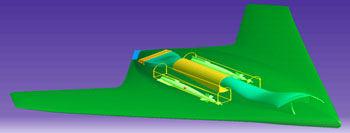
 A 'dry' version of the Kaveri turbofan engine will power the Indian Unmanned Strike Air Vehicle (IUSAV). Defence Minister A.K. Antony has informed Parliament about a variant of the Kaveri devoid of reheat/afterburner. In March this year, the Defence Research and Development Organisation (DRDO) had announced, "India’s first indigenously designed and developed aircraft engine Kaveri is undergoing certification tests after series of successful flight trials." The DRDO, is currently researching cornerstone technologies to make the IUSAV a reality.
The Indian Unmanned Strike Air Vehicle (IUSAV), under ab initio definition and concept development by the Aeronautical Development Agency (ADA) in Bangalore under Project Director Dr Biju Uthup, is being envisaged and developed as a stealthy autonomous bomber aircraft, incorporating flying wing aerodynamics, low observable features, long endurance capabilities, and the ability to deploy precision guided weapons over enemy territory. Several laboratories under the DRDO will participate in this ambitious aeronautical project.

One year of Akash SAM in service

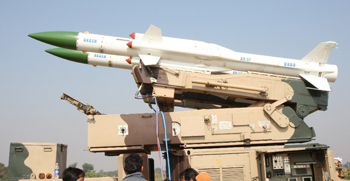
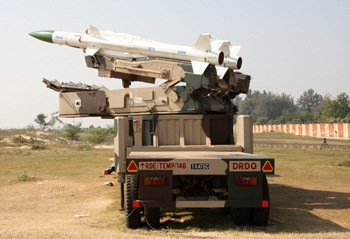
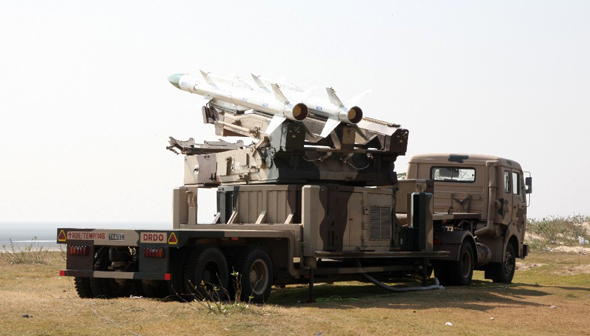
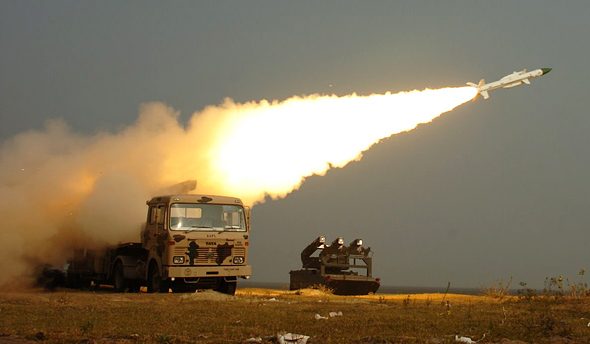
 The indigenous Akash surface-to-air missile (SAM) has completed a year in deployed service with the Indian Air Force. With two active squadrons now in Gwalior and Lohegaon and two more coming up in forward areas of the North East, the system is acquitting itself satisfactorily in terms of preparedness parameters. The Indian Air Force ordered eight squadrons (two in December 2008 and six more in December 2010), receiving its first battery in March last year. The first squadron was raised in Gwalior, the second in Pune and the next two are coming up in the Northeast.


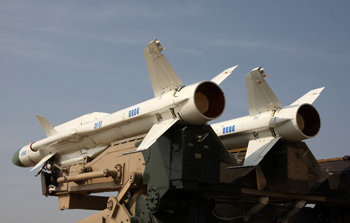
"The Akash is an extremely important system for the IAF. It has been a long development process, which has ended in success. The IAF is supporting the programme with its resources and commitment, and has been impressed with the capability it offers. We have ordered eight squadrons, which will replace the mission profile performed by our Pechora and OSA squadrons. In future, we may consider more," says a senior officer at Air HQ.
The IAF had an unfortunate series of failed customer tests in May-June last year, following the acceptance of units, though issues with the system were subsequently ironed out. The manufacture of the systems is being split between Bharat Electronics Limited (BEL) and Bharat Dynamics Limited (BDL) for the IAF and Army (the latter has on order two regiments, ordered in March 2011). Things started rough in 2012 with certain delivery hiccups from BEL slowing down inductions, though the public sector undertakings (PSU) has since speeded up deliveries to keep deadlines with the IAF. Sources indicate the IAF has received 32 launchers so far for four squadrons. The Army has received four launchers so far for part of its first regiment. The Army is incidentally, considering placing orders for additional regiments.
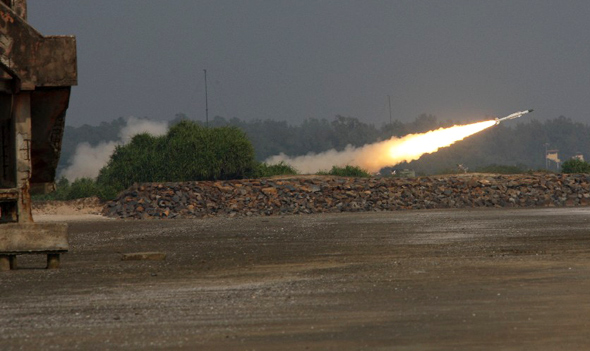
The IAF will be conducting user launches periodically this year from the Integrated Test Range is Odisha, and will test the Akash in various mission profiles including a) far boundary interception, b) near boundary interception, b) high altitude interception, c) crossing and receding target interception, d) low-altitude and near boundary, e) multiple target interception, f) low altitude and far boundary interception, g) mid-altitude and mid-range, h) crossing and approaching, in addition to others. These profiles were demonstrated during user trials between 2007-2010.
The Akash programme team is now also working on the Mk.II version of the Akash, a programme formally sanctioned in May 2010. The Mk.II version envisages a 35-km range weapon with an expanded kill envelope and a higher degree of engagement and accuracy.

Navy issues RFP for 9 MRMR aircraft


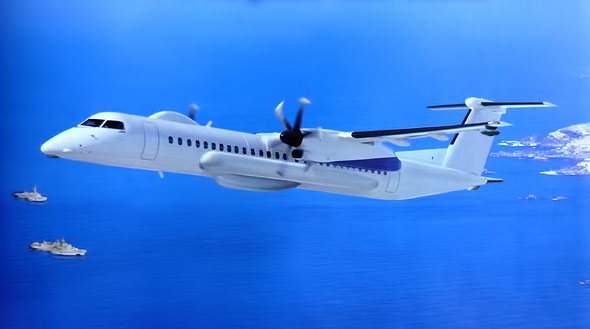
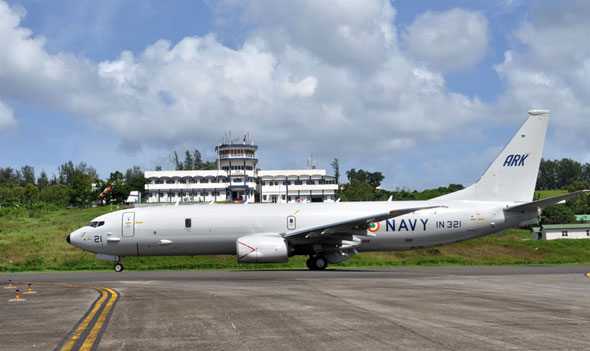
Following approval from the Defence Acquisition Council in February this year, the Indian Navy has sent out a long anticipated request for proposal (RFP) to vendors across the world for nine medium-range maritime reconnaissance aircraft. This acquisition looks to give the Navy aircraft with an operating range of at least 350nm and patrol time of at least 3.5-hours, clearly to augment mission profiles that will be served by 12 (8+4) new Boeing P-8Is.
The roles specified for the contending aircraft include maritime patrol, anti-surface warfare (two anti-ship missiles and jammer pod minimum), ELINT/ESM/ECM/COMINT and search and rescue. The likely contenders for this competition are likely to be IAI-Bombardier Q400 MP, the Saab 2000 MP, Embraer P99, Alenia ATR-72 MP, Dassault Falcon 900 MPA, Lockheed-Martin C-130J Sea Hercules, Boeing P-8I and EADS CASA C-295 MP.

Bombardier Q400 MP

Saab 2000 MP

Embraer P99

C-295

Alenia ATR-72 MP

Dassault Falcon 900 MPA

C-130J Sea Hercules

Boeing P-8I P8I

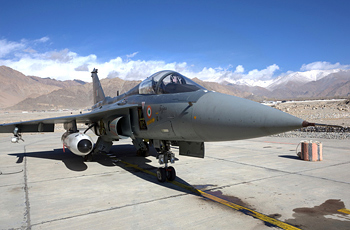
LCA Tejas requires a new radome


LCA Tejas As the Tejas speeds towards IOC-II, it appears that a crucial hurdle may slow it down, the platform needs a new radome. The Aeronautical Development Agency (ADA) has sent out an expression of interest to vendors to "design, develop and manufacture radome for LCA". The ADA's Directorate of Avionics & Weapon Systems in the EOI of September 2012 notes that it is "looking for alternative radome for LCA as part of their product improvement activity".
The EoI stipulates that the new radome is "to replace the existing radome with improved electromagnetic performance (EM) and with no change in existing geometry and pitot attachments." Also, the new radome needs to have identical geometry, though surface smoothness needs to be "equivalent or better". The document also suggests that the team testing the Tejas has issues with the lightning protection system of the existing radome and that there is rain water ingress at the radome-fuselage junction in the current structure.